
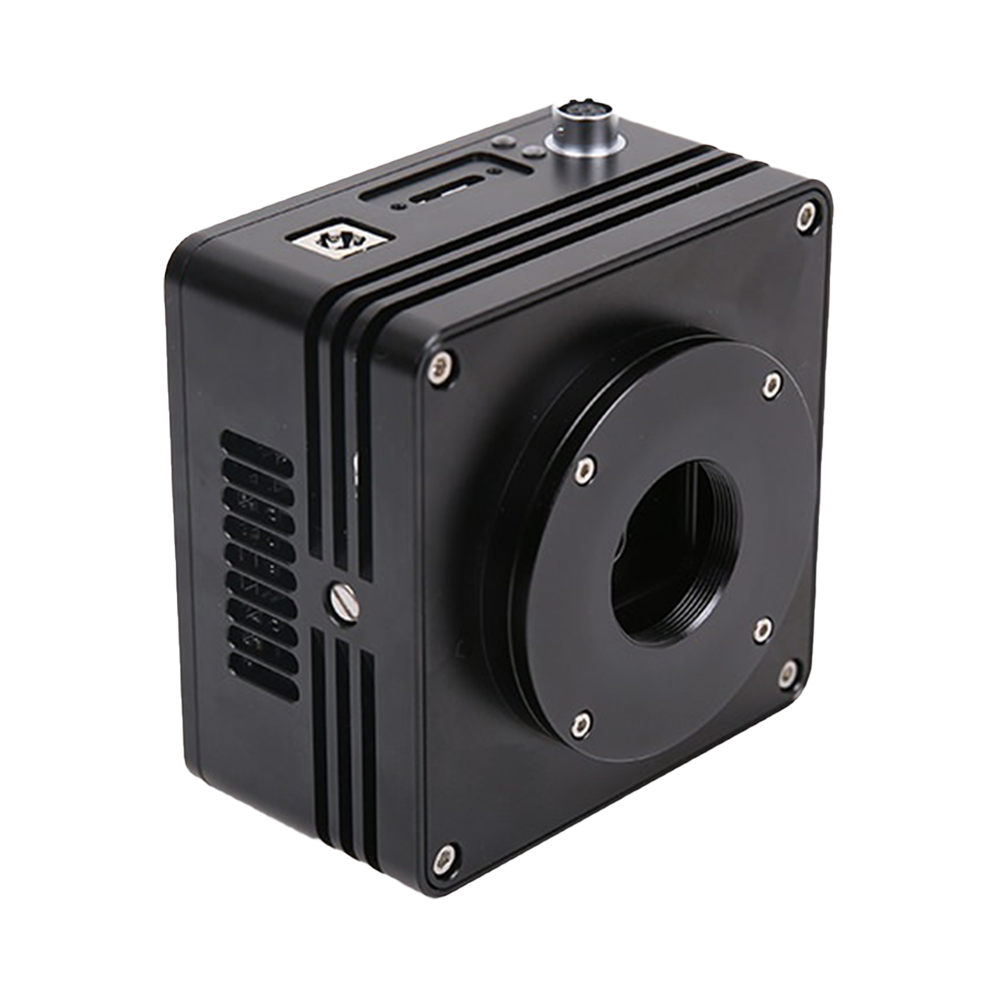
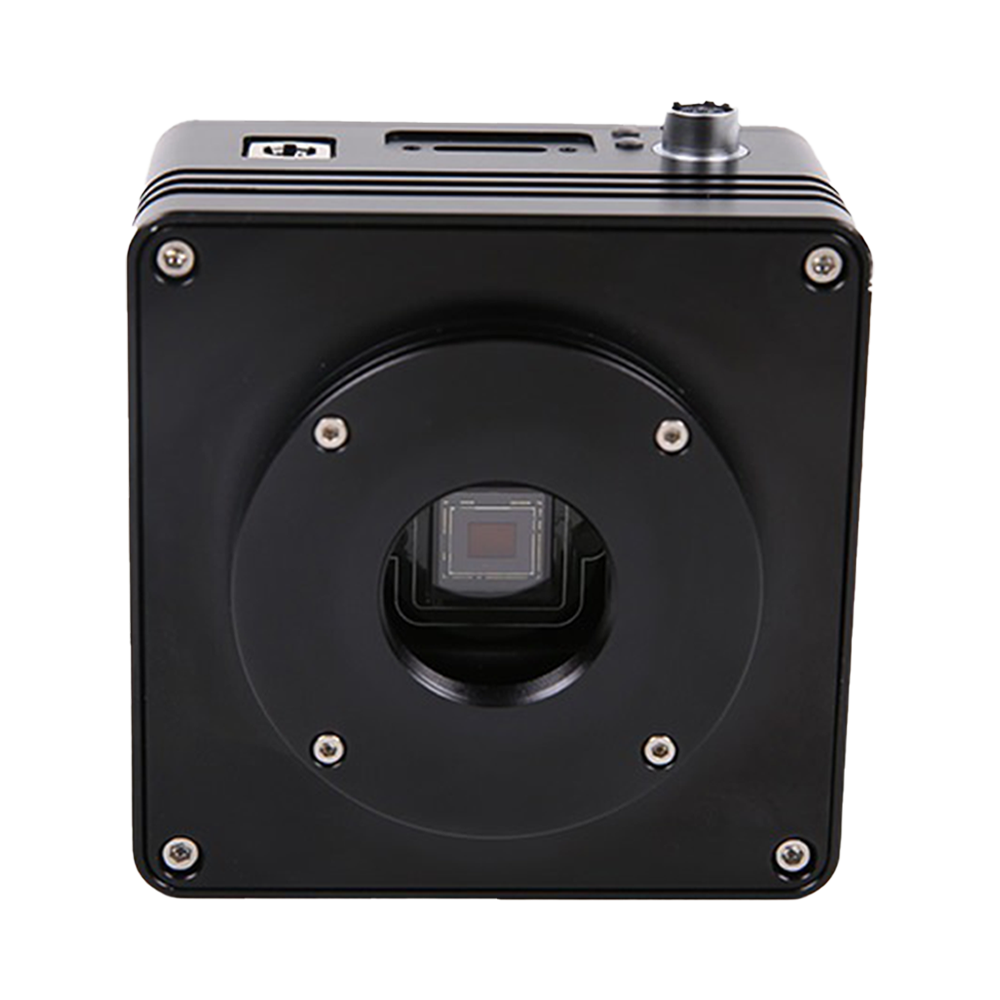
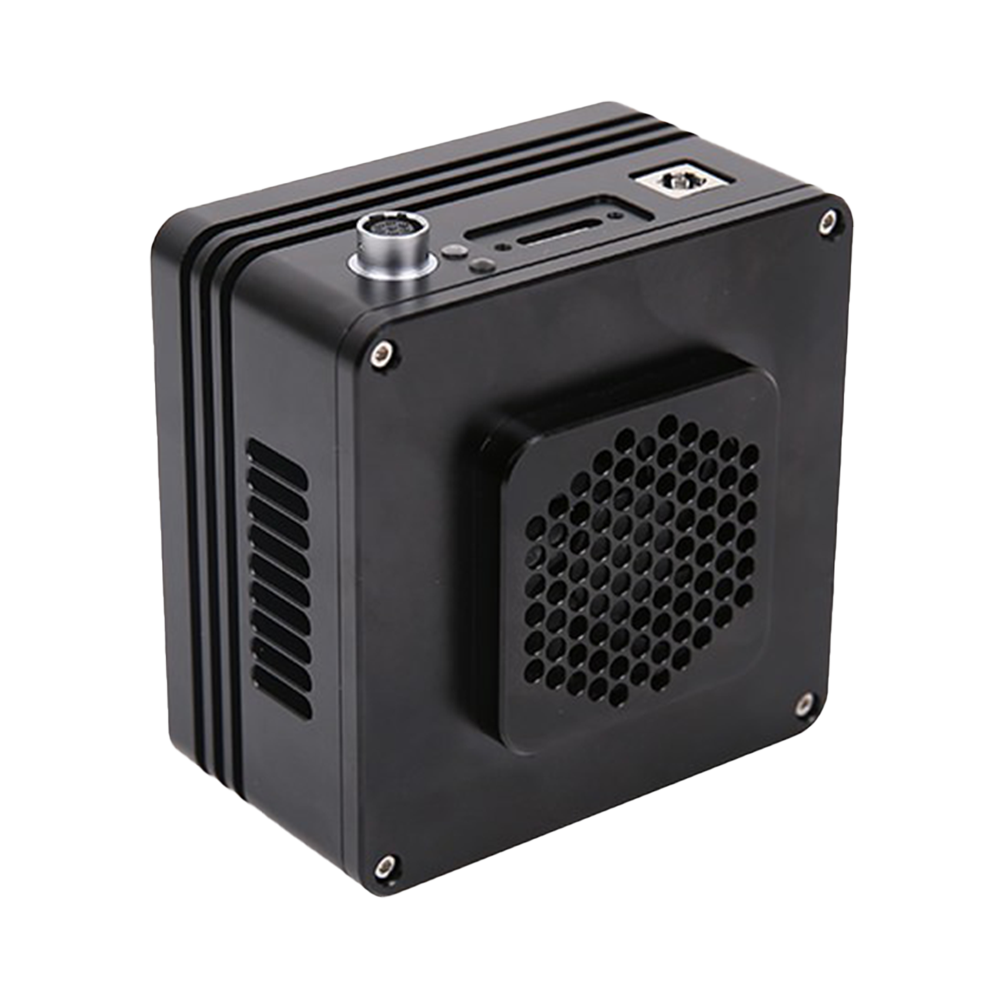
CTR3CMOS07100KPA Low Light Imaging/Semiconductor Cooled Camera
Product Introduction
7.1MP color global shutter cooled camera (IMX428) with USB3.0 interface, full resolution 51.3 fps, windowed up to 133.8 fps. TEC cooling (ΔT≈5–10 °C), closed-loop temperature control and anti-fogging structure, supports approximately 300 s long exposure, suitable for color low-light synchronous acquisition.
Key Features
- Sensor: Sony IMX428 (color, global shutter) 7.1MP
- Pixel/format: 4.5 µm; 1.1" (17.46 mm diagonal)
- Frame rate: 51.3 fps @ 3200×2200; up to 133.8 fps @ 1584×1100
- Interface: USB3.0; 8/12-bit output
- Dynamic range: 72 dB; sensitivity 2058 mV
- TEC cooling ΔT≈5–10 °C; closed-loop temperature control, anti-fogging
- Maximum exposure approximately 300 s (model dependent)
- Isolated trigger/strobe output + 2x GPIO
- Image functions: ROI, digital binning, mirroring, Gamma/LUT (model dependent)
- ToupView and cross-platform SDK
Product Details
| Key Parameters | |
| Model | CTR3CMOS07100KPA |
| Sensor | Sony IMX428LQJ |
| Effective Pixels / Resolution | 7.1MP (3200×2200) |
| Frame Rate (Full Resolution and Key Resolution Modes) | 51.3 fps @ 3200×2200; 133.8 fps @ 1584×1100 |
| Exposure Time | 6 µs ~ 300 s |
| Shutter Type | Global Shutter |
| Color Type | Color |
| Imaging Performance | |
| Pixel Size | 4.5 µm × 4.5 µm |
| Sensor Size | 14.4 mm × 9.9 mm |
| Diagonal | 1" (17.47 mm) |
| Dynamic Range | 72 dB |
| Bit Depth | 8-bit/12-bit |
| Sensitivity | 2058 mV |
| Interface & Mechanical | |
| Data Interface | USB3.0 |
| GPIO | 1x optically isolated input, 1x optically isolated output, 2x non-isolated I/O ports |
| Lens Mount | C-mount |
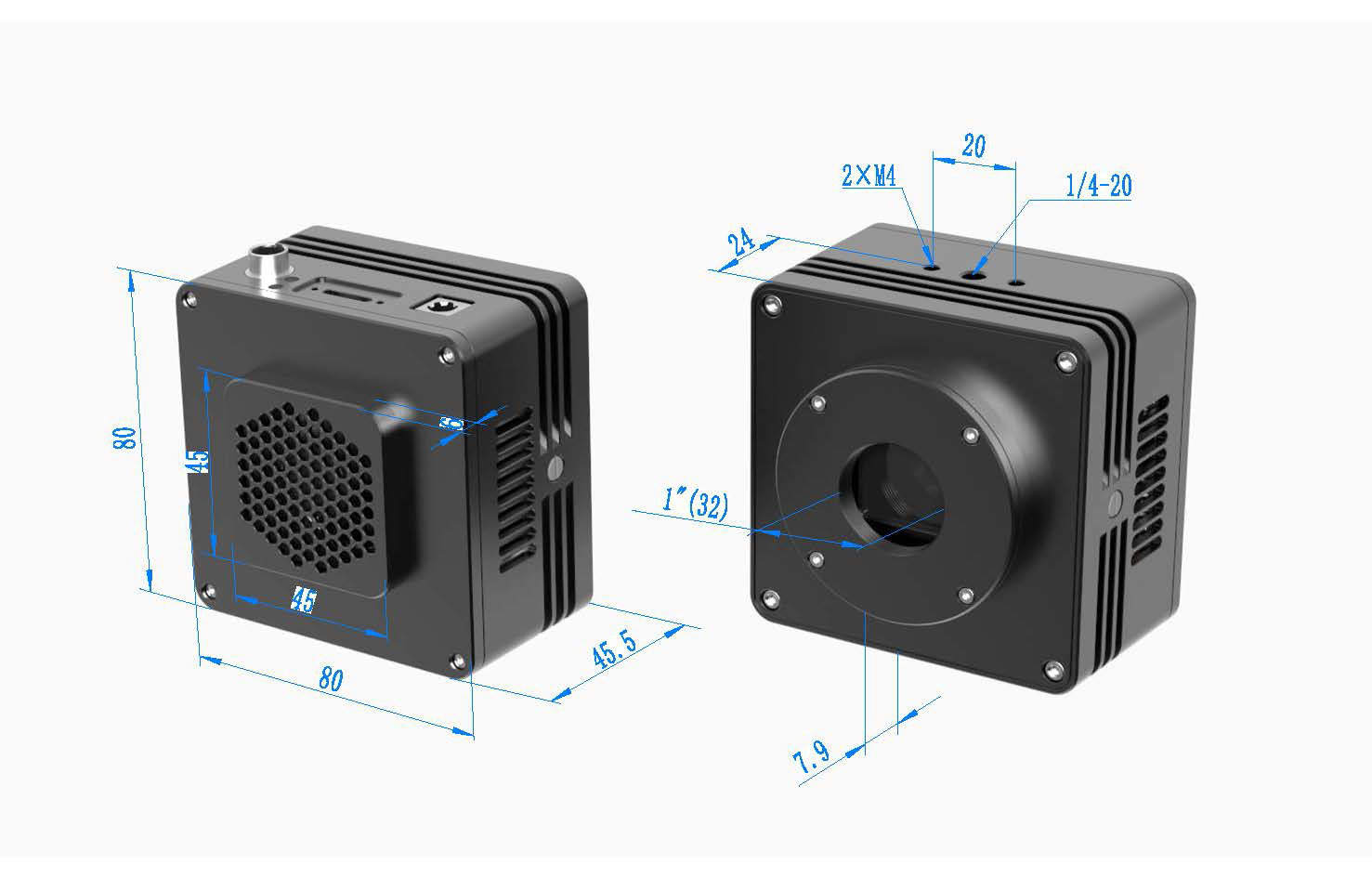
| Dimensions | 80 mm × 80 mm × 45.5 mm |
| Weight | 396.6 g |
| Power Supply | USB3.0 interface power / DC 12 V power |
| Environment & Certification | |
| Operating Temperature / Humidity | -10 °C ~ +50 °C / 20%-80% non-condensing |
| Storage Temperature / Humidity | -30 °C ~ +70 °C / Available on request |
| OS Support | Windows/Linux/macOS/Android multi-platform SDK (native C/C++, C#/VB.NET, Python, Java, DirectShow, TWAIN, etc.) |
| Certification | CE/FCC |
Product Overview
CTR3CMOS07100KPA is a scientific-grade cooled camera designed for low-light imaging and long exposure applications. It features the high-performance Sony IMX428LQJ image sensor with the following characteristics:
Core Performance Indicators
Cooling Capability
20 °C below ambient temperature
Maximum Exposure Time
Up to 1 hour
Typical Dark Current
0.07 mV @ -20 °C
Resolution
7.1MP (3200×2200)
Scientific Application Features
Astronomical Observation
Ultra-low noise and long exposure capability suitable for capturing dim targets such as deep-sky objects, comets, and nebulae.
Spectral Analysis
High dynamic range and linear response for precise spectral information recording, suitable for Raman spectroscopy and fluorescence spectroscopy applications.
Bioluminescence Imaging
Extremely high sensitivity for capturing weak signals from bioluminescence and chemiluminescence, supporting in vivo imaging research.
Long-Term Monitoring
Stable cooling system and anti-condensation design support long-term unattended scientific observation.
Recommendation
The CTR3CMOS07100KPA cooled camera, with its exceptional low-light detection capability, ultra-long exposure time, and scientific-grade image quality, is the ideal choice for astronomical observation, spectral analysis, bioluminescence imaging, and other low-light applications. Deep cooling technology effectively suppresses noise, while anti-condensation design ensures long-term stable operation, providing reliable imaging solutions for scientific research.
CTR3CMOS07100KPA Product Manual
PDF format with detailed technical specifications and dimensional drawings
SDK Development Kit
Supports Windows, Linux, macOS and other platforms
3D Model Files
STEP format for mechanical design integration
Packing List #
Current model CTR3CMOS07100KPA packing list (USB3 Cooled)
Recommended kit
- Camera body (CTR3CMOS USB3)
- Power adapter: input AC 100~240 V 50/60 Hz; output DC 12 V 3 A
- I/O cable: 7-pin cable or extension
- Micro USB 3.0 cable
- Lens (optional) C-mount

Product Dimensions #
Current model CTR3CMOS07100KPA dimensions (USB3 interface)
Deep Product Overview
Stable single-stage TEC cooling
Uses single-stage thermoelectric cooling that typically drops the sensor temperature about 10 °C below ambient, effectively suppressing dark current and improving long-exposure stability. Precise temperature control with anti-condensation design keeps it running reliably across environments, ideal for low-light imaging and unattended research observations.
High-performance backside-illuminated sensor
Equipped with Sony backside-illuminated CMOS sensors that deliver very high quantum efficiency and ultra-low read noise. Dual-gain modes and optimized electronics bring read noise down to 1 e⁻, preserving image quality in low light or long exposures. Pixel sizes from 2.4 µm to 4.63 µm balance high resolution with high sensitivity, giving a strong foundation for weak-signal capture.
Professional-grade imaging assurance
Supports 8-bit/12-bit output; 12-bit depth supplies ample gradation for research analysis. Typical dynamic range reaches 75 dB with SNR above 50 dB, meeting high-contrast scientific imaging needs. Flexible exposure control from 50 µs to several hours captures both fast events and deep-sky long exposures. The USB3.0 interface and large onboard buffer ensure stable delivery of high-resolution frames.
High-reliability industrial design
CNC metal housing with efficient thermal management keeps temperatures stable during long runs. The anti-condensation window prevents frosting at low temperatures, while the all-metal body offers strong electromagnetic shielding to reduce interference. Operating range is -10 to 50 °C, supporting long-term stability for around-the-clock research observations.
Complete software ecosystem support
SDKs are available for Windows, Linux, and macOS, supporting C/C++, Python, and other mainstream languages for fast integration into existing research systems. Standardized interfaces and complete documentation make it easy to embed the camera into telescopes, spectrometers, microscopes, and other scientific equipment. The single-cable USB3.0 power design simplifies deployment, with optional 12 V auxiliary power for even steadier cooling.